
토너먼트 고수들의 비법: Tim Adams, Dan Dvoress, Stephen Chidwick이 전하는 현대 포커 전략
📄 한국어 번역
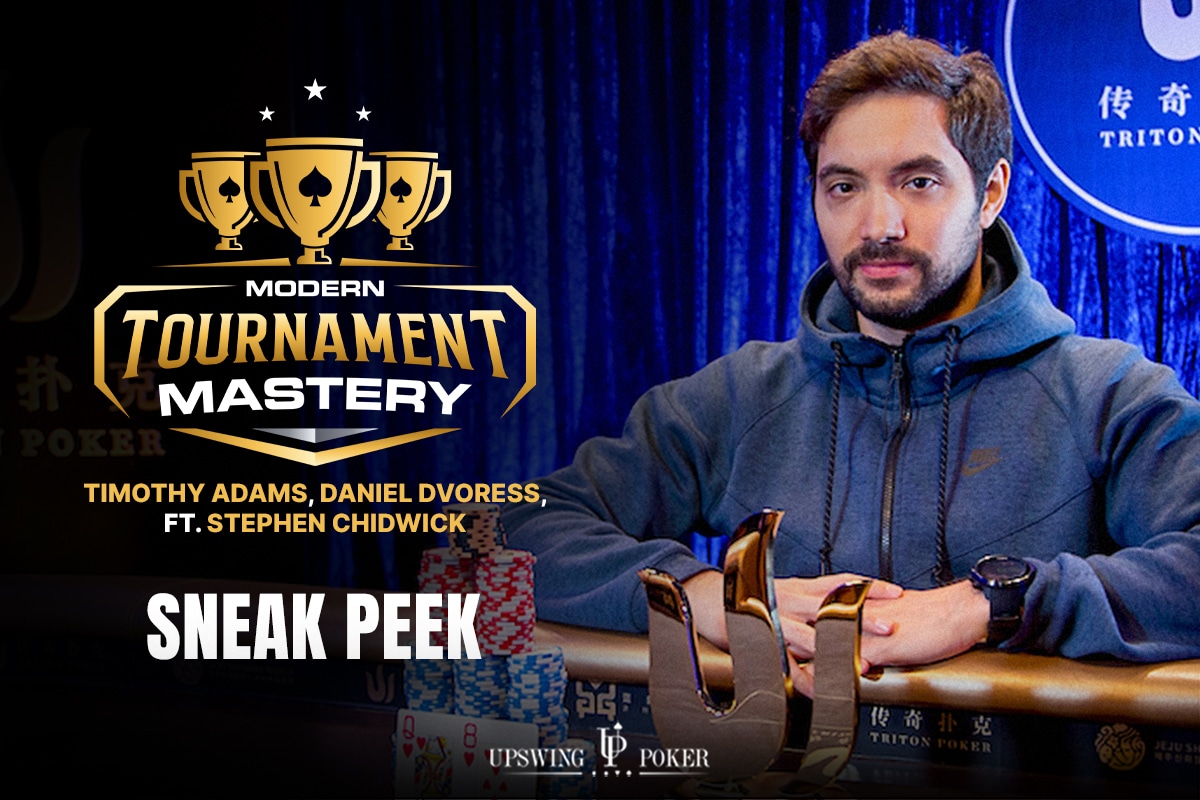
미리보기: Modern Tournament Mastery w/ Tim Adams & Dan Dvoress ft. Stephen Chidwick
토너먼트 포커를 하다 보면 진지한 플레이어라면 누구나 한 번쯤 뒤처지고 있다는 느낌을 받게 됩니다.
수개월을 공부하고 탄탄한 전략을 구축했더라도, 게임이 나를 앞질러 갔다는 느낌을 받는 상황에 직면하곤 합니다. 누군가 내가 완전히 이해하지 못한 라인을 사용하거나, 스택 다이내믹스가 급격하게 변하면서 평소의 편안한 영역에서 벗어나 공부하지 않은 상황으로 내몰리기도 하죠.
이런 느낌은 토너먼트 포커를 그토록 어렵게 만드는 요소이기도 하지만, 동시에 'Modern Tournament Mastery'와 같은 강의가 그만큼 가치 있는 이유이기도 합니다.
이 강의는 Timothy Adams가 이끌며 Daniel Dvoress가 함께하고, Stephen Chidwick이 게스트 코치로 참여합니다. 이들은 세계에서 가장 강력한 토너먼트 플레이어 3인방으로, 가장 수준 높은 필드에서 열리는 빅 이벤트들을 수년간 경험해 온 베테랑들입니다.
전례 없는 코칭 라인업
Timothy의 소개에서 즉각적으로 눈에 띄는 것은 놀랍게도 단순히 화려한 경력만이 아닙니다.
그는 포커 붐 시대부터 현재의 최고 하이 스테이크 게임에 이르기까지, 자신이 걸어온 포커 여정을 이야기하며 강의를 시작합니다. 그 과정에서 그는 자신이 뒤처진다고 느꼈던 순간들이 있었음을 솔직하게 고백합니다. 테이블에서 다른 플레이어들이 보여주는 플레이를 보며, 자신은 아직 그 감각을 제대로 익히지 못했다고 느꼈던 때가 있었다는 것이죠.
진지하게 게임에 임하는 플레이어라면 누구나 공감할 만한 부분입니다. 게임은 계속 진화하고, 스스로에게 솔직해진다면 현재의 내 이해도가 충분하지 않다는 것을 깨닫는 순간이 반드시 오기 때문입니다.
축하합니다: 이 강의의 마지막 촬영을 마치는 사이, 코치 Daniel Dvoress는 몬테네그로에서 열린 Triton 시리즈에서 $25K NLH Golden Decade와 $100K PLO 메인 이벤트를 우승하며 두 개의 타이틀을 추가했고, 희귀한 'Triton Trident'를 완성했습니다!
Timothy에게 그러한 느낌은 강력한 동기부여의 원천이 되었습니다. 그는 자신의 포커 철학이 '더 많은 지식이 곧 더 큰 힘'이라는 단순한 아이디어 위에 세워져 있다고 말합니다. 더 많은 정보를 가질수록, 시간이 지남에 따라 강력한 결정을 내릴 확률이 높아지기 때문입니다.
Timothy Adams의 포커 접근법
Timothy는 솔버 기반의 공부와 탄탄한 이론적 토대를 구축하는 것을 굳게 믿지만, 이론은 단지 시작점일 뿐이라는 점을 분명히 합니다. 우리가 그런 토대를 쌓는 이유는 상황이 요구할 때 더 자신 있게 조정(adjust)하기 위해서입니다.
"더 많이 알수록 그 토대에서 자신 있게 벗어나는 것이 더 쉬워집니다. 결국 우리가 상대하는 것은 사람이기 때문에, 이러한 유연성은 필수적입니다."
이 아이디어는 강의 전체를 관통합니다.
토너먼트 포커는 구조가 필요합니다. 다운스윙을 겪거나 자신감이 떨어졌을 때, 혹은 실시간으로 상황이 불분명할 때 기댈 수 있는 믿음직한 무언가가 필요하죠. 그것은 좋을 때나 나쁠 때나 활용할 수 있는 기준점(baseline)이 됩니다.
하지만 탑 플레이어들은 단순히 솔루션을 복사하는 것이 아닙니다. 그들은 이론, 대중적인 경향성(population tendencies), 라이브 리드, 메타게임, 직관, 그리고 토너먼트 상황을 모두 섞어서 사용합니다.
Timothy는 이를 다양한 입력값이 담긴 커다란 '접시'에서 선택하는 과정이라고 설명합니다. 때로는 이론적 기준점이 가장 중요한 요소일 때도 있고, 때로는 상대방이, 때로는 토너먼트 단계가 중요할 때도 있습니다. 또 때로는 라이브 리드나 대중적인 경향성이 당신을 다른 결정으로 이끌기도 합니다.
이 강의가 가르치고자 하는 것이 바로 이러한 의사결정 방식입니다.
지금 바로 확인하세요 — Modern Tournament Mastery: Tim Adams와 Dan Dvoress가 (Stephen Chidwick과 함께) 솔버 뒤에 숨겨진 '이유'를 가르쳐 주는 강의를 만들었습니다. 이제 여러분도 자신 있게 전략을 수정하고 모든 토너먼트를 정복할 수 있습니다.
보너스: Modern Tournament Mastery를 구매하시면 'Super High Roller Mechanics'를 무료로 드립니다. 이 혜택은 5월 29일 금요일 자정에 종료됩니다.
Modern Tournament Mastery 수강하기 →
단순히 레인지가 아닌, 사람을 상대하라
목표는 상대방을 최대한 자주 어렵고 무관심한(indifferent) 상황으로 몰아넣는 플레이어가 되는 것입니다. Timothy는 이를 간단하게 표현합니다.
"저는 기본적으로 여러분이 상대방이 어깨를 으쓱하게(무엇을 해야 할지 모르게) 만드는 그런 플레이어가 되도록 돕고 싶습니다."
이 문장은 이 강의가 왜 흥미로운지를 잘 보여줍니다.
상대하기 가장 까다로운 플레이어는 항상 가장 화려하거나 공격적인 사람이 아닙니다. 그들은 충분히 밸런스가 잡혀 있고, 충분히 공부했으며, 상대가 자신을 상대로 쉬운 결정을 내리지 못하게 할 만큼 충분히 인지하고 있는 플레이어들입니다. 그들은 기준점을 이해하고 있지만, 거기에 갇혀 있지 않습니다. 언제 압박을 가해야 할지, 언제 조정해야 할지, 그리고 언제 게임의 구조가 불확실성을 헤쳐 나가게 둘지 알고 있습니다.
가장 어려운 상황에서도 항상 무엇을 해야 할지 아는 것처럼 보이는 플레이어는 상대하기에 악몽과도 같습니다. 진지하게 게임에 임한다면, 여러분도 그런 플레이어가 되어야 합니다.
이 강의는 일반적으로 온라인 $200+ 토너먼트나 라이브 $1,000+ 토너먼트를 플레이하는 분들에게 가장 유용하겠지만, 개념 자체가 그 스테이크에만 국한되지는 않습니다. 낮은 스테이크 플레이어들도 엘리트 플레이어들이 전략을 어떻게 구성하는지 배우는 것만으로도 큰 도움을 받을 수 있으며, 특히 상위 스테이크로 올라가려는 분들에게는 더욱 그렇습니다. 하이 스테이크 플레이어들은 기본적인 토너먼트 개념보다는 프레임워크, 공부 습관, 그리고 엔드게임에 대한 논의에서 가치를 찾을 수 있을 것입니다.
강의 구성
강의는 Timothy가 어떻게 공부하는지, 어떤 도구를 사용하는지, 그리고 어떻게 실력을 향상시키는지 설명하며 시작합니다. 그 후, 스택이 100bb 이상으로 깊은 초기 단계부터 시작하여 토너먼트 포커의 주요 단계들을 차례로 다룹니다.
이 섹션은 포스트플랍 메커니즘, 카드 인터랙션, 그리고 나중에 중간 스택 깊이에도 적용할 수 있는 딥스택 원칙에 집중합니다. 어떤 영상은 구조화된 이론 수업이고, 어떤 영상은 '나와 함께 공부하자'는 느낌을 줍니다. Timothy는 프리플랍을 분석하고, 플랍 리포트를 살펴보고, 실제 테이블 밖에서 공부하는 방식 그대로 Lucid Poker 봇을 상대로 연습합니다.
이러한 형식은 강의 미리보기에서 가장 매력적인 부분 중 하나입니다. 단순히 결론만 얻는 것이 아니라, 그 결론을 도출해내는 과정 자체를 엿볼 수 있기 때문입니다.
초기 단계 섹션 이후, 강의는 토너먼트의 중간 단계로 넘어갑니다.
📰 Original (English)
Skip to content
Sneak Peek: Modern Tournament Mastery w/ Tim Adams & Dan Dvoress ft. Stephen Chidwick
Tournament poker has a way of making every serious player feel behind at some point.
You can study for months, build a strong strategy, and still run into spots where the game feels like it has moved past you. Maybe someone uses a line you don’t fully understand. Maybe the stack dynamics change quickly, taking you out of your comfort zone and forcing you into spots where you are unstudied.
That feeling is part of what makes tournament poker so challenging, but it is also what makes a course like Modern Tournament Mastery so valuable.
The course is led by Timothy Adams with Daniel Dvoress feat. Stephen Chidwick joining as a guest coach. These are three of the strongest tournament players in the world, with years of experience competing in the biggest events against the toughest fields.
An Unprecedented Coaching Lineup
What stands out immediately in Timothy’s introduction is, surprisingly, not just the résumé.
He opens the course by talking about his own path through poker, from the poker boom era to the highest stakes in the game. Along the way, he admits there were times when he felt behind the curve, watching other players do things at the table that he didn’t yet have a good feel for.
Every serious player can relate to that. The game keeps evolving, and if you are honest with yourself, there will be moments when you realize your current understanding is not enough.
Congratulations: Between final shoots for this course, coach Daniel Dvoress took down two more Triton titles in Montenegro, the $25K NLH Golden Decade and the $100K PLO Main Event, completing the rare Triton Trident!
For Timothy, that feeling became a major source of motivation. He says his poker philosophy is built around a simple idea: more knowledge is more power. The more information you have, the better chance you give yourself to make strong decisions over time.
Timothy Adams’s Approach to Poker
Timothy is a strong believer in solver-based study and building a solid theoretical foundation, but he is also very clear that theory is only the starting point. The reason you build that foundation is so you can adjust more confidently when the situation calls for it.
“The more you know, the easier it is to confidently deviate away from that foundation, which is essential because at the end of the day, we are playing people.”
That idea runs through the entire course.
Tournament poker requires structure. You need something reliable to fall back on when you are in a downswing, when your confidence is low, or when a spot feels unclear in real time. It’s a baseline you can utilize in both the best of times and the worst of times.
But the top players are not just copying a solution. They are using theory, population tendencies, live reads, metagame, intuition, and tournament context blended together.
Timothy describes this as choosing from a large “platter” of different inputs. Sometimes the most important factor is the theoretical baseline. Sometimes it is the opponent. Sometimes it is the stage of the tournament. Sometimes it is a live read or population tendency that nudges you toward a different decision.
That is the type of decision-making the course is trying to teach.
OUT NOW — Modern Tournament Mastery: Tim Adams and Dan Dvoress (ft. Stephen Chidwick) built a course that teaches you the why behind solvers, so you can confidently deviate and crush any tournament.
Bonus: Get Super High Roller Mechanics free when you grab Modern Tournament Mastery — offer expires Friday, May 29 at midnight .
Get Modern Tournament Mastery →
Playing People, Not Just Ranges
The goal is to become the player who forces opponents into difficult, indifferent spots as often as possible. Timothy puts it simply:
“I basically want to help you become that player who makes their opponents shrug their shoulders a lot.”
That line captures a lot of what makes the course interesting.
The hardest players to face are not always the flashiest or the most aggressive. They are the players who are balanced enough, studied enough, and aware enough that you rarely get an easy decision against them. They understand the baseline, but they are not trapped by it. They know when to apply pressure, when to adjust, and when to let the structure of their game carry them through uncertainty.
A player who always seems to know what to do in the toughest situations is a nightmare to deal with, and that is the kind of player you should want to be if you take the game seriously.
This course will likely be most valuable for players who generally play $200+ tournaments online or $1,000+ tournaments live, but the concepts are not limited to those stakes. Lower-stakes players can still benefit from learning how elite players organize their strategy, especially if they are trying to move up. Higher-stakes players may find value in the frameworks, study habits, and end game discussions rather than basic tournament concepts.
How the Course Is Structured
The course starts with Timothy explaining how he studies, what tools he uses, and how he approaches improvement. From there, it moves through the major stages of tournament poker, beginning with the early stages where stacks are often 100 big blinds or deeper.
This section focuses heavily on postflop mechanics, card interaction, and the deep-stack principles that can later be applied to middling stack depths. Some videos are structured theory lessons, while others have more of a “come study with me” feel. Timothy breaks down preflop, looks through flop reports, and drills against the Lucid Poker bot in a format that mirrors how he actually studies away from the table.
That format is one of the more appealing parts of the course preview. You are getting more than conclusions. You are getting a look at the process that produces them.
After the early-stage section, the course moves into the middle stages of tournaments, where the focus shifts more heavily toward preflop strategy. Timothy frames this around three pillars of mid-stage preflop play .
The first pillar is equal stacks . The second is big blind and mid-stack dynamics . The third, where Daniel Dvoress steps in, is when ICM starts to come into play as the min-cash gets closer.
Each pillar builds on the last, with the goal of giving you a more complete and structured preflop game. Daniel also covers how ICM influences postflop strategy, which becomes increasingly important as the course moves closer to the end game.
The End Game Section
The final section focuses on late-stage tournament play, including ICM-heavy preflop and postflop decisions. This is also where Stephen Chidwick joins Timothy for tournament video review, breaking down the Triton London Main Event from the bubble all the way to the eventual winner.
That part should be especially valuable because stream review is one of the ways Stephen and Timothy actually study together. Instead of only hearing what they think about tournament strategy in theory, you get to see how they work through hands, actual stack distributions, and payout pressure.
Modern Tournament Mastery is designed to make you a more well-rounded tournament player, with a stronger foundation, a better study process, and more nuance in the spots that matter most.
Why Modern Tournament Mastery Matters
There is plenty of technical material in the course: solves, drills, reports, preflop frameworks, ICM breakdowns, and high-level hand reviews. But the larger value is learning how players like Timothy Adams, Daniel Dvoress, and Stephen Chidwick organize that information into a complete tournament strategy.
Timothy makes one final point that is worth remembering:
“The harder you are to play against, the more likely it is that people will stay out of your way, the more EV you will gain via passivity from your opponents.”
That is a powerful tournament concept.
Some EV comes from the pots you win
출처: upswing — https://upswingpoker.com/sneak-peek-modern-tournament-mastery/
원문 게시일: 2026-05-28