

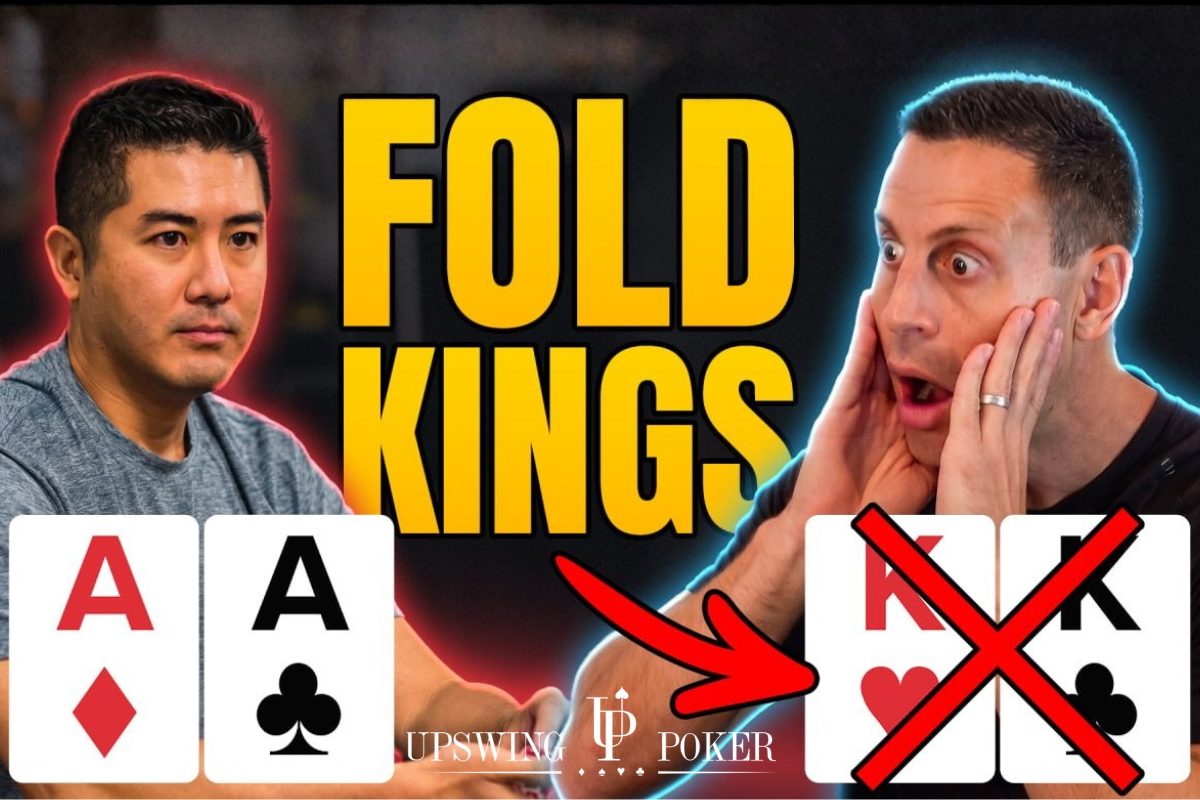
500bb 딥 스택에서 킹 대 에이스, 개럿 아델스타인은 과연 폴드할 수 있을까?
📄 한국어 번역
콘텐츠로 건너뛰기
에이스 대 킹, 500 빅블라인드 딥: 개럿은 여기서 다 죽을 수 있을까?
작성자: Duncan Smith · 온라인 캐시게임 프로
개럿 아델스타인(Garrett Adelstein)이 4벳 팟에서 킹 싯페어(Kh Kc)를 들고 있습니다. 플랍은 9 하이로 깔렸고, 이렇다 할 드로우도 보이지 않습니다.
대부분의 플레이어에게는 이 사실만으로 충분합니다. 칩은 전부 중앙으로 들어갈 것이고, 1,000bb 팟에서의 쿨러는 피할 수 없습니다.
하지만 앤디 차이(Andy Tsai)를 상대로 한 이 핸드는 핸드의 절대적인 강함 그 이상을 생각해야 하는 이유를 보여주는 좋은 예시입니다. 여기서 킹은 분명 개럿의 레인지 최상단에 근접해 있습니다. 하지만 더 중요한 것은 앤디가 실제로 팟에 엄청난 칩을 추가로 쏟아부을 만큼 충분히 나쁜 핸드(또는 충분한 블러프)를 가질 수 있는가 하는 점입니다.
개럿이 최종 결정을 내려야 할 시점에 이르러서는, 더 이상 그런 상황이 아니라고 판단합니다.
자신의 4벳과 5벳을 이해하라
게임은 $25/$50/$100에 $50 앤티이며, 유효 스택은 거의 500bb에 달합니다.
갈 이프라흐(Gal Yifrach)가 얼리 포지션에서 $300로 오프닝을 하고, 앤디가 에이스 싯페어(Ad Ac)로 $900 3벳을, 개럿은 버튼에서 킹 싯페어로 $3,000 콜드 4벳을 합니다. 갈은 폴드하고 앤디는 콜을 합니다.
개럿은 여기서 앤디의 전반적인 플레이 방식을 그리 마음에 들어 하지 않습니다. 대개 앤디가 이런 3벳 이솔레이션으로 꽤 타이트하게 액션을 가져가는 편이면서도, 테이블의 스택 딥을 고려했을 때 작은 사이즈를 사용했기 때문입니다.
개럿은 앤디가 여기서 5벳 레인지를 가져야 한다고 생각하지만, 그렇다고 에이스로 플랫(콜)을 한 것이 실수라는 뜻은 아닙니다. 오히려 개럿은 특히 이렇게 스택이 깊고 강한 상대를 상대로는, 가끔 에이스를 트랩(Trap)하는 것도 지극히 합리적이라고 생각합니다.
실수는 5벳 레인지를 아예 가지고 있지 않는 것입니다.
"여기서 99부터 QQ까지만 콜하고 다른 건 아무것도 안 하는 사람이 되지 마세요."
9월 8일 개럿 아델스타인의 새로운 강좌 '라이브 캐시 마스터하기'
역사상 가장 두려움의 대상인 라이브 캐시 플레이어 중 한 명이 거대한 팟을 어떻게 공략하는지 배워보세요. 실제 핸드, 실제 리드, 실제 익스플로잇. 웨이팅 리스트 등록하기 →
앤디의 4벳 콜링 레인지는 여전히 꽤 타이트해야 하지만, 개럿은 미들 및 하이 포켓 페어로만 거의 독점적으로 구성된 레인지는 불충분하다고 믿습니다. 수딧 브로드웨이 카드, 오프수딧 에이스-킹, 심지어 적은 수의 수딧 커넥터나 낮은 페어 같은 핸드들도 모두 말이 됩니다. 일부 핸드는 400% 4벳에 콜하겠다는 구체적인 의도를 가지고 3벳을 할 수도 있습니다.
개럿은 이 아이디어를 자신의 4벳 레인지에도 적용합니다.
"여기서 A4와 A5 수딧으로만 4벳하고 다른 건 안 하는 사람이 되지 마세요."
A5 수딧은 4벳 레인지에서 명백한 블러프 후보 중 하나일 수 있지만, 개럿은 거기서 멈추고 싶어 하지 않습니다. 오프수딧 브로드웨이, 수딧 커넥터, 그리고 일부 수딧 킹들도 이런 스택 딥에서는 낮은 빈도로 섞어줄 수 있습니다.
이것이 라이브 포커의 프리플랍을 솔버 연습처럼 만들겠다는 뜻은 아닙니다. 실력이 좋은 상대가 당신의 레인지를 몇 가지 뻔한 핸드로 곧바로 좁혀버릴 정도로 예측 가능해지는 것을 피하기 위함입니다.
플랍에 뜬 킹은 멋져 보인다
플랍은 9d 5h 5c 입니다.
앤디가 체크하고, 개럿은 $6,525 팟에 $3,000을 베팅합니다.
개럿은 4벳을 한 뒤 이 보드에서 매우 높은 빈도로 베팅할 것으로 예상합니다. 그의 레인지는 강하고, 보드는 극도로 드라이하며, 킹은 정확히 거대한 팟을 쌓아나가기 시작하고 싶은 그런 핸드로 보이기 때문입니다.
그러자 앤디가 $8,400로 작게 체크-레이즈를 하고, 경보음이 울리기 시작합니다.
5벳 레인지를 가진 상대를 상대로는 에이스나 킹의 일부 조합, 혹은 모든 조합을 디스카운트(할인)할 수 있습니다. 하지만 앤디에게 5벳 레인지가 없다는 개럿의 믿음을 고려하면, 여기서는 그럴 수 없습니다.
그는 앤디가 여기서 에이스의 6가지 조합을 전부 가질 수 있다는 것을 알고 있습니다.
하지만 폴드를 고민하기엔 너무 이릅니다. 개럿은 좋은 오즈(가격)를 받고 있고, 앤디가 블러프를 하고 있을 수도 있으며, QQ-TT 같은 밸류로 더 약한 핸드를 들고 있을 가능성도 있습니다.
그래서 개럿은 레이즈에 콜을 합니다.
플랍에 3벳을 할 밸류는 별로 없어 보입니다. 앤디의 더 약한 밸류 핸드들을 폴드시킬 수도 있는 반면, 앤디의 가장 강한 핸드들은 개럿이 레이즈로 다시 판을 키우면 기꺼이 칩을 더 집어넣을 것입니다. 콜을 함으로써 개럿은 한 스트리트 더 진행하며 정보를 얻을 수도 있습니다.
포켓 킹으로 더블 체크-레이즈를 맞다
턴은 3s 이고, 앤디는 플랍 체크-레이즈에 이어 다시 한번 체크를 합니다.
개럿은 이제 $23,325가 된 팟에 $6,000을 베팅합니다. 앤디가 여전히 더 약한 오버페어를 많이 가지고 있을 수 있으므로 이 베팅에는 밸류가 있습니다. 하지만 개럿은 또한 이 특이한 플랍 액션 이후 AK이나 AQ 같은 핸드에게 AK나 AQ 같은 핸드에게 공짜 카드(프리카드)를 주고 싶어 하지도 않습니다.
그러자 앤디는 개럿의 턴 베팅에 거의 $30,000을 추가로 잼(올인)합니다.
이로 인해 개럿에게는 모든 공식이 완전히 바뀌어 버립니다.
이제 중요한 질문은 "킹이 얼마나 강한가?"가 아닙니다. 대신 "앤디가 가지고 있는 블러프는 무엇인가?"가 됩니다.
개럿의 대답은 기본적으로 '없다'입니다.
이것이 바로 앤디의 라인이 가진 문제입니다. 개럿이 턴 체크 자체를 반대하는 것은 아닙니다. 이전 스트리트에서 공격적인 액션을 취했더라도, 강한 핸드는 가끔 체크를 해야 할 필요가 있습니다.
하지만 플랍에서 체크-레이즈를 하고 턴에서도 오직 굿핸드(좋은 핸드)를 가졌을 때만 또다시 체크-레이즈를 한다면, 실력 있는 상대들이 간단하게 돈 주는 것을 멈춰버릴 정도로 지나치게 뻔하고 강한 라인을 만들어 버린 셈입니다.
여기서 개럿이 하는 말은 이 핸드 국한되지 않습니다. 강한 상대를 상대로 특이한 밸류 라인을 쓰고 싶다면, 그것을 뒷받침할 블러프 조합이 반드시 있어야 합니다. 실제 플레이에서 그런 블러프를 도저히 찾아낼 자신이 없다면, 애초에 그 밸류 라인을 타지 않는 편이 나을 수도 있습니다.
앤디가 정말 더 약한 밸류로 이럴 수 있을까?
킹을 실제로 폴드하기 전에, 개럿은 아직 답해야 할 질문이 하나 더 남아 있습니다.
앤디가 단순히 더 약한 오버페어를 밸류 목적으로 오버플레이하고 있는 것은 아닐까?
많은 상대를 상대로라면, 그 가능성만으로도 콜하기에 충분할 것입니다. 개럿은 그 점을 아주 명확히 합니다. 레크레이셔널 플레이어라면 오버페어를 들고 달리 할 줄 몰라 이 라인을 탔을 수도 있습니다. 또 다른 누군가는 그냥 버튼을 마구 눌러대고 있었을지도 모릅니다.
이런 상대들을 상대로는, 상대가 나를 이기고 있을 때 가끔 돈을 잃어주는 것이 베스트 핸드를 폴드하는 위험을 감수하는 것보다 낫습니다.
앤디는 다릅니다. 개럿에게는 그와 쌓아온 수많은 히스토리가 있기 때문입니다.
그는 방송에서든 아니든 수년 동안 앤디와 플레이해 왔고, 그의 성향을 연구해 왔으며, 앤디가 퀸은 물론이고 잭이나 텐을 가지고 이 특이한 라인을 탔을 리는 거의 없다고 확신합니다.
개럿이 일단
📰 Original (English)
Skip to content
Aces vs Kings, 500 Big Blinds Deep: Can Garrett Get Away?
By Duncan Smith · Online Cash Game Pro
Garrett Adelstein has Kh Kc in a 4-bet pot; the flop comes 9-high, and there are no real draws to speak of.
For most players, that’s all that needs to be said. The money is going in, and a cooler in a 1,000bb pot is inevitable.
But this hand against Andy Tsai is a good example of why you should think beyond your hand’s absolute strength. Kings are obviously near the top of Garrett’s range here. What’s more important, though, is whether Andy can actually have enough worse hands (or enough bluffs) to justify putting another enormous chunk of money into the pot.
By the time Garrett faces the final decision, he no longer thinks that’s the case.
Know Your 4-bets and 5-bets
The game is $25/$50/$100 with a $50 ante, and the effective stacks are close to 500bb.
Gal Yifrach opens the action to $300 from early position, Andy 3-bets to $900 with Ad Ac , and Garrett cold 4-bets to $3,000 from the Button with his KK. Gal folds, and Andy makes the call.
Garrett doesn’t love Andy’s overall approach here, largely because Andy was fairly active with these 3-bet isolations, while also using a small size given the stack depths in play at the table.
Garrett does think Andy should have a 5-betting range here, although that doesn’t make flatting aces a mistake. In fact, Garrett thinks sometimes trapping aces is perfectly reasonable, particularly this deep against strong opponents.
Having no 5-bet range at all is the mistake.
“Do not be the guy who only calls with 99 through QQ here and nothing else.”
September 8 Garrett Adelstein's New Course Destroy
Live Cash Learn how one of the most feared live cash players ever attacks massive pots. Real hands, real reads, real exploits. Join the Waitlist →
Andy’s 4-bet calling range should still be fairly tight, but Garrett believes a range consisting almost exclusively of medium and high pocket pairs is insufficient. Hands like suited Broadway cards, ace-king offsuit, and even a small number of suited connectors or lower pairs can all make sense. Some hands can be 3-bet with the specific intent of calling a 4-bet every time.
Garrett applies the same idea to his own 4-betting range:
“Do not be the guy who only 4-bets A4 and A5 suited here and nothing else.”
A5 suited may be one of the obvious bluffing candidates in a 4-bet range, but Garrett doesn’t want to stop there. Offsuit Broadway, suited connectors, and some suited kings can all be mixed in at low frequency, even at these stack depths.
This isn’t intended to turn preflop in live poker into a solver exercise. It’s to avoid becoming so predictable that a good opponent can immediately narrow your range to a few obvious hands.
Kings Look Great on the Flop
The flop is 9d 5h 5c .
Andy checks, and Garrett bets $3,000 into $6,525.
Garrett expects to bet this board at a very high frequency after 4-betting. His range is strong, the board is extremely dry, and kings look like exactly the kind of hand he wants to start building a huge pot with.
Then Andy check-raises small, to $8,400, and alarm bells start going off.
Against an opponent with a 5-bet range, you could discount some combinations of aces and kings , or even all combinations. However, given Garrett’s belief that Andy doesn’t have a 5-bet range, that doesn’t apply here.
He knows Andy can have all six combinations of aces here.
However, it’s too soon to start thinking about folding. Garrett is getting a great price, Andy could be bluffing, and it’s possible he could have worse for value like QQ-TT.
So Garrett calls the raise.
He doesn’t see much value in 3-betting the flop. He may fold out Andy’s worse value hands, while Andy’s strongest hands are perfectly happy to keep piling money in if Garrett reopens with a raise. Calling also gives Garrett another street of information.
Getting Double Check-Raised With Pocket Kings
The turn is the 3s , and Andy checks again after check-raising the flop.
Garrett bets $6,000 into the pot, now worth $23,325. There’s value in this bet, since Andy can still have plenty of worse overpairs, but Garrett also doesn’t want to give a free card to something like AK or AQ after the unusual flop action.
Andy then jams over Garrett’s turn bet for almost another $30,000.
This changes the whole equation for Garrett.
The important question is no longer, “How strong are kings?” Instead, it’s “What bluffs does Andy have?”
Garrett’s answer is basically none.
This is the issue with Andy’s line. Garrett doesn’t object to the turn check by itself. Strong hands do need to check sometimes, even after taking an aggressive action on the previous street.
But if you check-raise the flop and then check-raise again on the turn only when you have the goods, you’ve created an overly strong line that good opponents can simply stop paying off.
Garrett’s point here applies beyond this hand. If you want to use an unusual value line against strong opponents, you need some way to support it with bluffs. If you know you’re never going to find those bluffs in practice, it may be better not to take that value line at all.
Can Andy Ever Do This With Worse Value?
Before actually folding kings, Garrett still has to answer one more question:
Could Andy simply be overplaying worse overpairs for value?
Against many opponents, that possibility would be enough to call. Garrett is very clear about that. A recreational player might take this line because he has an overpair and doesn’t know what else to do. Someone else might simply be clicking buttons.
Against these opponents, it’s better to just lose sometimes when your opponent has you beat than to risk folding the best hand.
Andy is different because Garrett has so much history with him.
He has played with Andy for years, on stream and off it, has studied his tendencies, and feels extremely confident that Andy is almost never taking this particular line with queens, let alone jacks or tens.
Once Garrett removes those hands, Andy’s range starts looking very ugly for Kh Kc .
The value hands beat him, the worse made hands barely exist, and Garrett can’t find the bluffs.
At this point, against an opponent you know exceedingly well, just having kings isn’t enough to stack off.
When an Unusual Line Is Actually Just the Effective Nuts
Garrett finishes with a useful way of separating different player types in spots like this.
When a bad player takes a line that makes no sense, calling can often be right because bad players do things that make no sense. They overvalue hands. They click buttons, not knowing or caring what the right action is. They show up with hands you never would have put in their range. You generally can’t hero fold very strong hands against a bad player.
A decent reg can be a different story.
That player often knows his line looks suspicious. In some cases, that’s exactly why he chooses it with a monster. He expects you to look at the action, decide it doesn’t make sense, and pay him off. “This looks bluffy” is a justification regs have been using as long as poker has existed.
Garrett believes he has made a lot of money over the years doing the opposite.
The very best players are hard to play against because they can find the bizarre-looking value line and the bizarre-looking bluff. You can’t just chalk a weird line up to value because bluffing is hard when you’re playing a world-class opponent.
Andy, in Garrett’s view, wasn’t doing enough of the second part.
That’s why this hand is more useful than a simple highlight-reel fold. Garrett didn’t fold because he suddenly decided pocket kings were no longer a strong hand. He folded because years of experience playing with Andy made Andy’s range completely transparent, to the point where neither worse value nor bluffs could exist .
Preorder
the Book Beneath the Cards is an unforgettable ride appealing to poker fans, business professionals, sports and true crime readers, and anyone intrigued by the pri
출처: upswing — https://upswingpoker.com/aces-vs-kings-500-big-blinds-deep-can-garrett-get-away/
원문 게시일: 2026-08-21