

턴에서 크게 베팅해야 할 때 3가지와 피해야 할 때 3가지
📄 한국어 번역
턴(Turn)에서 최적의 벳 사이즈를 선택하는 것은 유리할 때 더 많은 돈을 따고 불리할 때 덜 잃는 데 도움이 됩니다. 따라서 언제 어떤 사이즈를 골라야 하는지 아는 것은 승률을 극대화하는 데 매우 중요합니다.
턴에 도달하는 방법은 매우 다양하며(인포지션 vs 아웃 오브 포지션, 싱글 레이즈 팟 vs 3벳 팟 vs 4벳 팟, 플랍 체크 후 vs 플랍 벳 후 등), 이를 단 하나의 글로 모두 다룰 수는 없습니다. 그렇기 때문에 이번 글에서는 싱글 레이즈 팟에서 인포지션으로 플랍 씨벳(c-bet)을 한 이후, 오버벳으로 크게 베팅해야 하는 상황 3가지와 그렇게 하지 말아야 할 상황 3가지를 분석해 보겠습니다.
바로 시작해 봅시다!
큰 베팅을 해야 할 때
상황 #1 – 턴에 블랭크(무난한 카드)가 떨어졌을 때
상대방이 당신의 플랍 씨벳에 단순히 콜만 한 이후라면, 그들은 플랍 투페어의 절대다수를 제거할 수 있습니다. 왜냐하면 그런 패들이라면 체크-레이즈를 했을 것이기 때문입니다. 이로 인해 상대방은 많은 턴 카드에서 심각한 넛(nut) 열세에 처하게 됩니다.
보통 이 경우는 턴 카드가 콜러(caller)의 레인지에 있는 드로우들을 크게 완성시켜주지 않을 때 발생합니다. 당신은 플랍 투페어 이상의 핸드를 전부 가지고 있으면서 턴에서 운 좋게 맞은 핸드들도 몇 개 더 추가하는 반면, 상대방의 투페어 이상 영역은 대부분 턴에 어떤 카드가 떨어지느냐에 따라 좌우되기 때문입니다.
자, 그렇다면 왜 넛 우위가 이러한 베팅 사이즈 전략을 유도하는 것일까요? 바로 수학 때문입니다.
더 구체적으로 말하자면, 당신이 더 크게 베팅하더라도 상대방이 익스플로잇 당하지 않기 위해 수학적으로 수많은 약한 핸드들로 콜을 계속해야만 하는 상황에 놓이기 때문입니다. 이로 인해 레인지의 상단에 있는 핸드로 매우 큰 사이즈를 구사하면서도 약한 핸드들의 콜을 받아내는 것이 매우 수익성 높아집니다.
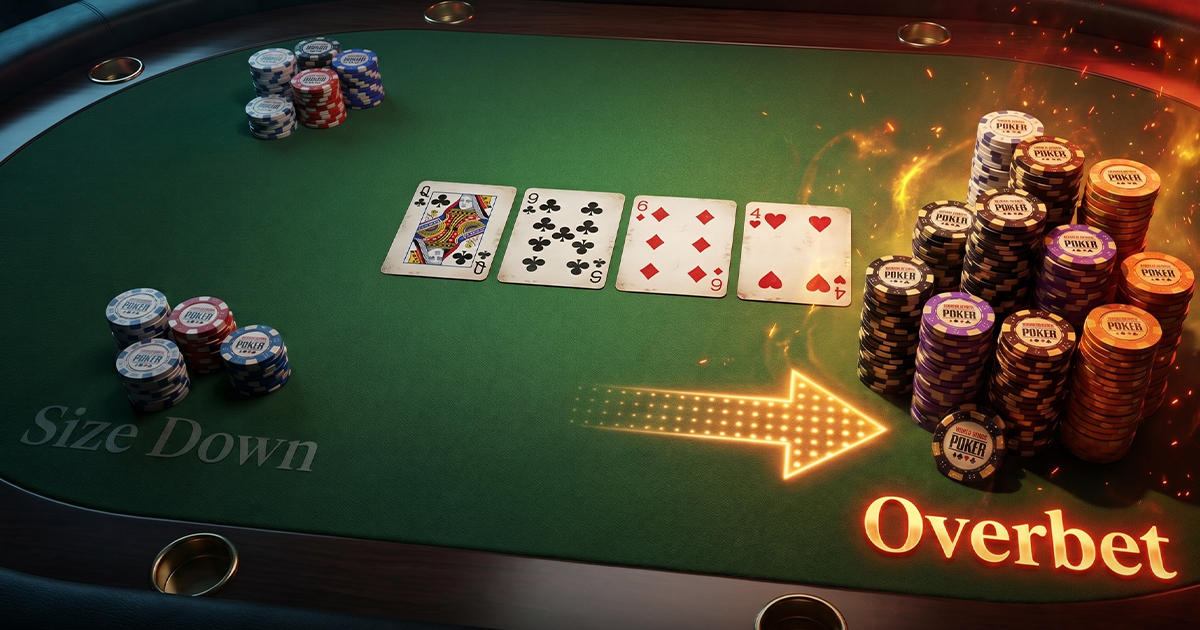
간단한 예시를 들어보겠습니다. 당신이 버튼(Button)에서 오픈 레이즈를 하고 빅블라인드가 콜을 했습니다. 당신이 Qc 9c 6d 플랍에 씨벳을 하고, 빅블라인드가 콜합니다. 턴에 4h가 떨어집니다. 빅블라인드가 체크하고, Upswing의 Lucid Poker 솔버가 보여주는 최적의 전략은 다음과 같습니다:
순수 오버벳 또는 체크.
상황 #2 – 하이 카드 플랍이 나온 후 턴에 오버카드(Overcard)가 떨어졌을 때
이전 상황과 유사합니다. 플랍에서 씨벳을 했을 때 상대방이 아웃 오브 포지션에 있다면, 그들은 오버카드 형태의 핸드 대다수를 폴드하는 반면 당신은 그런 핸드들의 상당 부분으로 씨벳을 날렸을 것입니다.
이로 인해 턴에 오버카드가 떨어졌을 때 당신에게 유리한 매우 비대칭적인 탑페어 분포가 형성됩니다. 뿐만 아니라, 그 탑페어들은 투페어에 거의 준하는 에퀴티를 갖습니다. 빅블라인드는 플랍에서 자신의 투페어 대다수(전부는 아니더라도)를 체크-레이즈했을 것이고, 현재는 세컨페어 선에서 레인지가 캡(Cap)되어 있기 때문입니다.
이러한 상황을 살펴보겠습니다. 다시 버튼 대 빅블라인드 구도입니다. Qh 8h 4d 플랍에서 당신이 씨벳을 하고 콜을 받았습니다. 턴은 Kd였고, 최적의 전략은 다음과 같습니다:
이번에도 오버벳 위주의 전략이며, 새로 만들어진 모든 탑페어들이 이쪽으로 몰려듭니다. 참고로 이 상황에서 당신은 13.6%의 확률로 탑페어를 갖는 반면, 상대방은 5.8%의 확률로만 가집니다.
당신은 상대방보다 거의 2.5배 더 많은 탑페어를 가지고 있습니다. 또한 투페어 이상 영역도 상대방의 두 배에 달합니다. 이것이 바로 최적의 전략이 그토록 공격적인 이유입니다. 상대방이 수많은 더 약한 핸드들로 방어하도록 수학적으로 강제되는 동안, 당신은 밸류를 최대한으로 뽑아내고 싶어 하는 것입니다.
상황 #3 – 턴에 보드가 페어(Pair)가 되었지만 레인지에 스트레이트 이상이 많이 있을 때
이 상황은 대개 플랍에 스트레이트가 깔려 있었을 때 발생합니다. 그렇습니다, 턴이 상대방에게 수많은 셋(Trips)을 만들어 주기는 하지만, 상대방의 핸드 강도는 그 선에서 캡되어 있는 반면 당신의 레인지에는 스트레이트와 풀하우스가 존재할 수 있습니다.
형태만 다를 뿐 개념은 여전히 동일합니다. 핵심 아이디어는 변함없이, 상대방에 비해 가장 강력한 핸드를 가질 확률이 당신에게 훨씬 더 높다는 점입니다. 절대적인 핸드 강도는 중요하지 않습니다.
개념적으로 볼 때, 상대방은 서드페어에서 캡되어 있고 당신은 수많은 세컨페어를 가지고 있는 상황일 수도 있습니다. 그렇다면 그 세컨페어들은 밸류를 위한 오버벳 핸드가 될 것입니다. 혹은 가상의 시나리오에서 상대방이 플러시에서 캡되어 있을 수도 있습니다.
만약 당신이 풀하우스를 가지고 있다면, 오버벳을 합니다. 결국 이 모든 것은 핸드 클래스 간의 에퀴티 차이에 관한 것입니다.
다음으로, 크게 베팅하면 안 되는 상황 3가지를 다루어 보겠습니다.
바로 들어가 봅시다!
크게 베팅하면 안 될 때
상황 #1 – 턴에 플러시가 완성될 때
자, 여기까지 잘 따라왔다면 아웃 오브 포지션의 콜러는 이론상으로도 플랍 콜링 레인지를 캡해 둔다는 사실을 기억할 것입니다(실전에서보다 이론상 슬로플레이가 더 자주 일어나긴 하지만 말이죠).
하지만 콜을 한다고 해서 디펜더가 콜을 이어가는 플러시 드로우의 양까지 캡되는 것은 아닙니다. 이는 플러시가 완성되는 턴 카드에서 상대방 레인지 구성에 큰 영향을 미칩니다.
만약 당신과 상대방 모두 실질적인 넛 핸드를 대등한 수준으로 가질 수 있다면, 이는 그 매우 강력한 핸드들과 자주 부딪치지 않고는 아주 큰 사이즈로 베팅할 수 없음을 의미합니다. 그것이 꼭 나쁜 것은 아니지만, 문제는 오직 그 초강력 핸드들로만 밸류 벳을 하고 싶어 하지는 않는다는 점입니다.
그 바로 아래 티어의 핸드들 역시, 리버가 카드를 너무 약하게 만들어 밸류 벳을 할 수 없게 되기 전에 미리 밸류를 뽑아내고 싶어 합니다.
예시를 들어보겠습니다. 동일하게 버튼 대 빅블라인드 구도이고, 플랍은 Qs 9s 6d입니다. 당신이 75% 베팅하고 상대가 콜합니다. 턴은 4s입니다. 최적의 전략은 다음과 같습니다:
잠시 오른쪽에 주목해 주시기 바랍니다. 메이드 핸드 섹션을 살펴보면, 이 75% 팟 사이즈에서는 우리가 밸류와 보호를 위해 탑페어만큼 약한 핸드로도 밸류 벳을 해야 한다는 것을 알 수 있습니다.
만약 솔버에게 오버벳 사이즈, 이 경우 팟의 135%만을 사용하도록 강제한다면 어떤 일이 벌어질까요:
이 사이즈로 밸류 벳을 할 수 있는 투페어가 거의 없기 때문에, 결국 밸류 레인지는 대폭 축소되고 셋과 플러시 위주로만 남게 됩니다.
📰 Original (English)
Skip to content
3 Times You Should Bet Big on the Turn (And 3 Times You Shouldn’t)
Sizing your bets optimally on the turn can help you win more money when you are ahead and lose less when you are behind. Knowing when to choose one size over the other is thus important for maximizing your win-rate.
There are many ways to reach the turn (in position vs out of position, single raised pots vs 3-bet pots vs 4-bet pots, after checking on the flop vs betting on the flop, etc.) and I can’t cover them all in just one article. For this reason, in this one, I am going to break down 3 spots where you should bet big with an overbet, and 3 spots where you shouldn’t after c-betting in position on the flop in a single-raised pot.
Let’s get into it!
When You Should Go Big
Spot #1 – When the turn is a blank
After your opponent only calls your flop c-bet, you can eliminate the vast majority of his flopped two-pairs as they will have check-raised . This puts them at a very large nut disadvantage on a lot of turn cards.
Usually, this happens when the turn doesn’t complete many draws in the caller’s range. That is because you retain all of your flopped two-pair+ hands and add a few more lucky hitters on the turn while your opponent’s two-pair+ region mostly hinges on what it hits on the turn.
Now, why does nut advantage incentivize this type of bet sizing strategy? Math.
More specifically, it has to do with the fact that you can bet larger and your opponent is still mathematically forced to continue with a bunch of weak hands to remain unexploitable. This makes it very profitable for the top of your range to go for very large sizes and still get called by weak hands.
Quick example here. You open-raised on the Button and got called by the Big Blind. You c-bet the Qc 9c 6d flop, and the Big Blind calls. The turn comes the 4h . The Big Blind checks, and here’s what the optimal strategy looks like in Upswing’s Lucid Poker solver:
Pure overbet or check.
Spot #2 – When there was a high card flop and then an overcard came on the turn
This is similar to the previous one. What happens when you c-bet on the flop and your opponent is out of position is that they will fold the vast majority of their overcard-type hands while you c-bet with a large part of them.
This creates a highly asymmetric top pair distribution in your favor when an overcard hits on the turn. Not only that, but those top pairs almost have the equity of two-pair. That is because the Big Blind will have check-raised the vast majority (if not all) of his two-pairs on the flop and he’s mainly capped at second pair now.
Let’s take a look at a spot like this. Again looking at playing from the Button against the Big Blind. You c-bet and got called on a Qh 8h 4d flop. The turn was the Kd and here’s what the optimal strategy looks like:
Again, an overbet-heavy strategy, where all the new top pairs flock to. For context, you have a top pair 13.6% of the time in this spot, while your opponent only has one 5.8% of the time.
You have almost 2.5x more top pairs than him. You also have double his two-pair+ region. This is why the optimal strategy is so aggressive. You want to extract the maximum value while he’s mathematically forced to defend with many weaker hands.
Spot #3 – When the turn pairs the board but you have many straights+ in your range
This typically happens when there was a straight on the flop. Yes, the turn does make a bunch trips for him, but he’s capped at that hand strength, while you can have straights and full houses in your range.
The concept still applies, just in a different form. The idea remains the same, you have significantly more of the strongest possible hands in that situation relative to your opponent. The absolute hand strength doesn’t matter.
From a conceptual standpoint, it could be that he’s capped at third pair and you have a bunch of second pairs. Then those second pairs would become overbets for value. It could also be that your opponent is capped at flushes in a hypothetical scenario.
If you have full houses, then you overbet. At the end of the day, it’s all about the equity differential between the hand classes.
Next, I am going to cover 3 spots where you shouldn’t go big.
Let’s dive in!
--> September 8 Garrett Adelstein's New Course Destroy
Live Cash Learn how one of the most feared live cash players ever attacks massive pots. Real hands, real reads, real exploits. Join the Waitlist →
When You Shouldn’t Go Big
Spot #1 – When the turn completes a flush
So, if you’ve been following along, you will remember that the out of position caller is capping his flop calling range even in theory (although you will see more slowplaying going on there than in practice).
However, what calling doesn’t cap is the amount of flush draws that the defender continues with by calling. This has a big impact on their range composition on flush-closing turns.
If both yourself and the opponent can have the effective nuts in roughly equal amounts, it means that you cannot bet a very large size without running into those very strong hands often. That is not necessarily a bad thing but the problem is that you don’t want to value bet with only those super strong hands.
The tier of hands immediately below them also want to extract value before the river makes the hand too weak to value bet with.
Here’s an example. Same Button vs Big Blind scenario, flop is Qs 9s 6d . You bet 75%, he calls. The turn is the 4s . Here’s what the optimal strategy looks like first:
I want you to focus on the right hand side for a second. If you look at the made hands section, you will see that for this 75% pot size, we should be value betting with hands as weak as top pair for value and protection.
If we force the solver to only use the overbet size, 135% pot in this case, here’s what happens:
Barely any two-pairs can value bet at this size, so we end up shrinking our value range greatly. Mostly sets and flushes.
From these two images, if we look at the bottom left corners, we will see that we started off with an EV of 7.05bb/hand for the Button, and when we handcuff it to only use 135%, it dropped to 6.88bb/hand. That’s a 17bb/100 win-rate loss that comes directly from capping our value extraction.
Spot #2 – When the turn completes straights
Usually, one straight completing is not enough. That is because one straight usually represents a very small amount of combos from the overall range, which is not enough to make overbetting run into too many super strong hands.
Quick example. Same Qs 9s 6d flop, with a 5h turn this time. We see the solver using 150% pot exclusively:
That being said, if the turn completes an offsuit draw, then the story changes as there are many more combos that are now straights, somewhere in the range of 4x more. In this case, we see the solver tuning down the sizing significantly, mostly going for 75% pot again:
It all has to do with how often you’d end up facing a very strong hand when overbetting. The higher the proportion of those hands in villain’s range, the smaller your bet sizing should be. This allows you to keep value betting thinner, extract value and deny equity at the same time.
Spot #3 – When there was a low flop and then an overcard came on the turn
Final spot on this list. In the first section of this article, we saw that when an overcard came on the turn, we should overbet. The difference then was that the flop already contained a high card. For reference, here’s that model again:
Now, if we take a different flop, 9h 7h 4d in this case, where your 75% pot c-bet got called, and the turn brought the Kc , here’s what the GTO approach looks like:
Pure 75% pot or check back.
Now, why might that be?
It’s not because we have fewer top pairs or better, on the contrary.
It’s a combination of two things: there are more two-pairs in Big Blind’s range and we have hands that are value-worthy yet vulnerable.
Firstly, there are more two-pairs in Big
출처: upswing — https://upswingpoker.com/3-turn-spots-go-big-3-spots-shouldnt/
원문 게시일: 2026-07-03