

토너먼트에서 솔버가 권장하는 더 큰 베팅 사이즈 전략
📄 한국어 번역
토너먼트에서 언제 큰 사이즈의 베팅이 솔버가 승인하는 최선의 플레이인가
좋은 핸드, 큰 베팅. 보통은 그렇다.
솔버 이전 시대에는 팟의 절반 정도를 씨벳(c-bet)하는 것이 표준은 아니더라도 꽤 흔한 일이었다.
새로운 밀레니엄의 2000년대 초반, 한 젊은 루마니아 선수가 노 리밋 텍사스 홀덤 토너먼트에서 새로운 전략을 들고 등장한다. 당시에는 다소 엉뚱하고 도박적인 변칙 전략이었다. 그는 자신의 접근 방식을 "스몰 볼(small ball)"이라고 명명했다. 당시 플레이어들이 4배 이상의 오픈 레이즈와 팟의 50% 씨벳을 하던 환경에서, 그는 미니 레이즈와 더 작은 사이즈의 씨벳을 구사했는데, 이는 과거에 유행했던 변칙적인 스타일을 연상케 했다.
다니엘 네그라누의 전략은 대중화되었고, 작은 베팅 사이즈는 새로운 표준이 되었다.
자, 이제 시간을 좀 더 돌려보자.
2010년대 초반, 포커계는 솔버 시대의 서막을 맞이한다. 스몰 볼과 유사한 전략을 선호하는 것이 새로운 메타가 되었다. 매번 큰 사이즈로 베팅하는 것은 매우 비용이 많이 드는 플레이 방식이기 때문에 지양해야 했다. 하지만 그게 다가 아니었다.
큰 베팅 사이즈가 다시 돌아오고 있다.
한때는 큰 사이즈의 씨벳을 사용하는 것이 어떤 포커 세대 출신인지, 즉 세련되지 못한 '스트리트 포커'를 구사하는지 보여주는 징표였다. 지금은 어떤가? 큰 베팅은 솔버가 승인하거나, 어떤 경우에는 선호하는 방식이 되어 메타의 일부로 자리 잡았다.
프로들이 어떻게 큰 씨벳을 활용하는지 배울 준비가 되었는가?
시작해보자.
빅 씨벳이란 무엇이며 왜 사용하는가?
내 생각에 빅 씨벳이란 팟의 50%를 초과하는 모든 베팅을 의미한다. 다른 이들은 팟의 67%, 75%, 혹은 83%에서 기준을 잡을 수도 있다.
사실 그건 중요하지 않다.
중요한 것은 상대방의 레인지가 레인지 베팅(예: 팟의 20%, 25%, 33%)을 선택하지 않을 때 어떤 행동을 하는가이다.
더 큰 베팅 사이즈는 레인지의 폴라라이제이션(polarity, 양극화)이 심화되었음을 의미한다.
이는 중간 정도의 콤보가 줄어들었다는 뜻이다.
프리플랍에서 폴라 레인지는 조금 더 정적이다. AA나 KK 같은 최고의 핸드들은 Ax나 Kx 같은 쓰레기 핸드들과 균형을 이룬다. 대개 그런 식이다.
포스트플랍에서 폴라 레인지는 전혀 정적이지 않다. 포스트플랍 폴라 레인지에 무엇이 포함될지는 보드 텍스처에 의해 결정된다.
예를 들어, 당신이 As Ac를 들고 있고 플랍이 9h 8h 7d라고 가정해보자.
정말로 이 핸드로 팟을 키우고 싶은가?
아마 아닐 것이다.
대신, 이 보드와 잘 연결되거나 최소한 상대방의 콜링 레인지와 경쟁할 수 있는 핸드를 사용하는 편이 낫다.
왜 단순히 레인지 베팅만 할 수 없는가
작은 사이즈의 씨벳은 보통 꽤 괜찮은 전략이다.
비용이 저렴하기 때문에 레인지에 있는 모든 핸드를 활용할 수 있다.
작은 베팅은 더 넓은 콜링 레인지를 유도하므로, 강한 메이드 핸드로 밸류를 챙길 수 있다. 반대로, 에어(air)나 드로우 핸드는 저렴한 비용으로 상대의 자동 폴드를 유도할 수 있다.
A72 무지개 보드를 예로 들어보자.
당신이 오픈하고 빅 블라인드가 콜했다. 당신은 작게(팟의 25~33%) 씨벳을 한다.
당신의 Ax는 상대의 더 약한 메이드 핸드들을 잡아낸다(당신의 A9o vs 상대의 A4s, 87o, 55).
당신의 블러프는 상대의 더 나은 노메이드 핸드들을 폴드하게 만든다(당신의 89s vs 상대의 Q5s).
깔끔하고 효과적이다.
작은 사이즈의 씨벳은 많은 플랍 텍스처에서 꽤 훌륭하다.
하지만 항상 그런 것은 아니다.
작은 씨벳이 매우 효율적이긴 하지만, 작은 사이즈를 사용하는 것이 오히려 상대방에게만 이득이 되는 상황이 많다. 우리는 그런 상황을 원하지 않는다.
그런 경우들에 대해 이야기해보자.
런아웃이 에퀴티를 변화시킬 때
에퀴티 변화를 이해하는 간단한 방법은, 핸드에 참여한 최소 한 명의 플레이어가 5장의 카드를 모두 보는 것에서 이득을 얻으며, 이를 위해 최선을 다할 것이라는 점이다. 보드의 유형과 관련된 레인지에 따라, 어떤 경우에는 일방적인 효과가 나타나고 어떤 경우에는 양방향의 효과가 나타난다.
에퀴티 변화를 이야기할 때, 다이내믹한 보드(흔히 "젖은" 보드라고 함)가 가장 먼저 떠오른다. 이런 보드들은 상황이 매우 복잡하다. 높은 원 페어 상호작용과 수많은 드로우, 플러시, 스트레이트가 한쪽 또는 양쪽 레인지에 존재한다.
몇 가지 예를 살펴보자.
예시 1. BTN vs BB, 유효 스택 50bb, 보드 876 무지개.
당신은 버튼이다. 2.2bb로 오픈 레이즈를 했다. 빅 블라인드가 콜한다.
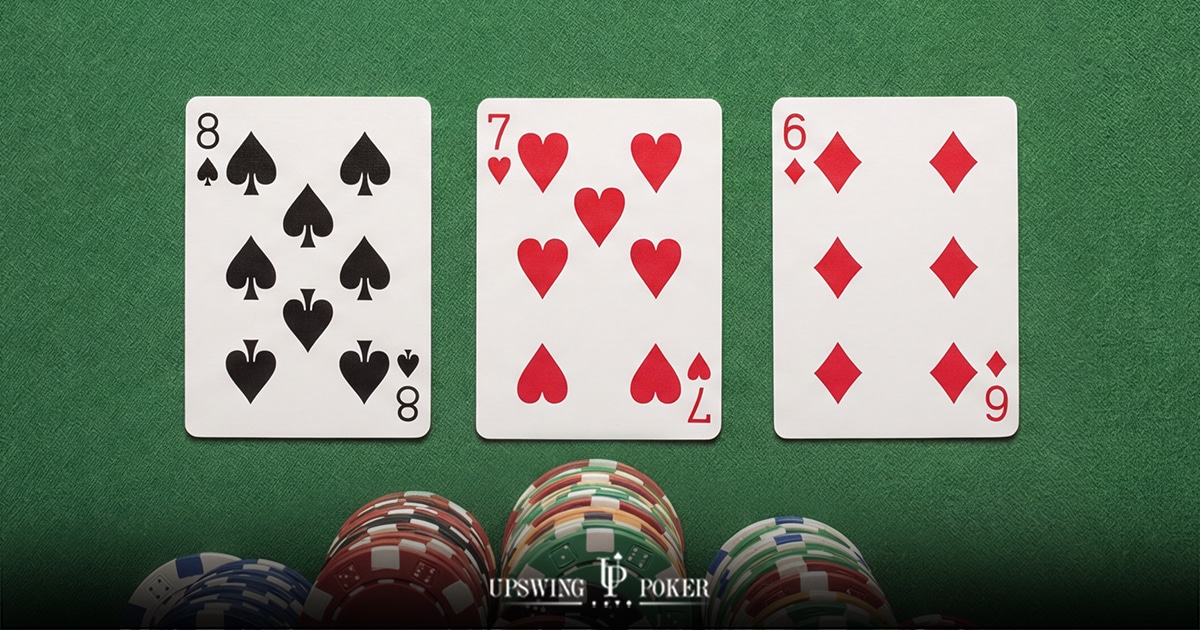
딜러가 8s 7h 6d 보드를 깐다.
턴에서 당신의 레인지는 어떻게 되는가?
오버페어를 가지고 있을 때, T, 9, 8, 7, 5, 4는 모두 문제가 되는 카드들이다. 남은 47장의 카드 중 23장이 그렇다. 만약 작게 베팅한다면, 빅 블라인드는 이 모든 카드를 보고 계속 플레이할 수 있다. 턴에서 상대 레인지의 절반 정도가 개선될 것이다.
한번 살펴보자.
Lucid Poker – 유효 스택 50bb. 876 무지개 보드에서 버튼의 33% 팟 씨벳을 마주한 BB의 레인지. BB는 모든 드로우로 콜을 이어간다.
여기서 작게 베팅하면, 상대방이 자신의 레인지 중 상당 부분으로 에퀴티를 실현하게 해준다. QQ 같은 핸드를 들고 있을 때는 이상적이지 않다.
작은 사이즈는 당신 레인지의 높은 에퀴티 핸드들에게 문제가 된다. 이는 버튼이 작은 사이즈(33%)를 거의 사용하지 않는다는 점에서도 드러난다. 사용 빈도는 1%에 불과하며, 이는 솔버의 노이즈일 뿐이다.
이제 선호되는 75% 팟 사이즈를 사용했다고 가정해보자. 빅 블라인드의 레인지는 어떻게 변하는가?
아래를 보라.
Lucid Poker – 유효 스택 50bb. 876 무지개 보드에서 버튼의 75% 팟 씨벳을 마주한 BB의 레인지. BB는 33% 사이즈를 마주했을 때보다 20% 더 많이 폴드한다.
75% 팟의 큰 씨벳을 마주하면, 빅 블라인드의 폴드 빈도는 약 42% 증가한다.
빅 블라인드는 바텀 거샷 스트레이트 드로우, 일부 바텀 오픈엔디드 스트레이트 드로우, 일부 6x(바텀 페어), 그리고 가장 약한 7x(미들 페어)를 폴드한다. 여기서 핵심은 '에퀴티 디나이얼(equity denial, 에퀴티 차단)'이 중요하다는 점이다.
직관에 반하는 사실이지만, 때로는 가장 좋은 핸드일수록 상대의 핸드를 겁주어 폴드시키는 것이 이득일 때가 있다. 더 나쁜 핸드들로부터 밸류를 뽑아내는 게 더 좋지 않냐고? 꼭 그렇지는 않다.
상대 레인지의 최상단과 높은 에퀴티를 가진 핸드들을 묶어두는 것만으로도 충분한 승리다. 왜냐하면 이 핸드들은 결국 스택이 들어갈 수 있기 때문이다. 빅 씨벳은 적절한 핸드 클래스로부터 최대 이득을 취하는 것뿐만 아니라, 에퀴티를 차단하는 것이기도 하다.
걱정해야 할 것은 빅 블라인드가 가진 4x 콤보의 4아웃이 아니라, 이후 스트리트에서의 불확실성이다. 그들의 4x를 폴드시키는 것은 좋은 일이며, 미래의 런아웃으로 인해 당신의 QQ를 폴드해야만 하는 상황을 방지해준다. A8s 같은 핸드들도 같은 취약성을 겪으며 비슷하게 플레이된다.
지금 앞서고 있고 미래가 불확실할 때, 큰 베팅은 좋은 아이디어다.
자, 이제야 제대로 된 젖은 보드다.
📰 Original (English)
Skip to content
Now Powered By
Play Online
Now Powered By
Play Online
When Betting Bigger Is the Solver-Approved Play In Tournaments
Big hand. Big bet. Usually .
In the pre-solver era, continuation betting for half pot was fairly common, if not the norm.
It’s the early aughts of the new millennium. A young Romanian breaks onto the scene with a new strategy for No Limit Texas Hold’em poker tournaments: a silly, gambly variant of the game. He coins a name for his approach, “small ball.” In a format where players opened for >4x and c-bet for 50% pot, he min-opens and c-bets smaller, reminiscent of the variants that used to rule the day.
Daniel Negreanu’s strategy becomes popular. Small sizes become the new normal.
Ok. Fast forward.
It’s the early 2010s. The poker world sees the nascency of the solver era . A preference for a small ball-like strategy is the new meta. You really don’t want to bet chunky sizes all the time because that’s a very expensive way to play. But there’s more.
Large sizes are making a comeback.
For a minute, using a larger c-bet size was a telltale of what poker generation you were from: unsophisticated street poker. Now? It has worked its way into the meta, a result of being solver approved, or in some cases, preferred .
Ready to learn how the pros deploy big c-bets?
Let’s begin.
What is a Big C-Bet and Why Even Use It?
IMO, a big c-bet is anything greater than 50% pot. Others might disagree and draw the line at 67% pot, 75% pot or 83% pot.
It doesn’t really matter.
What matters is whatever your opponent’s range is doing when they choose not to range-bet (i.e. 20%, 25%, 33% pot).
Larger bet sizes signal increased range polarity .
That just means less middling combos.
Preflop , a polar range is a little more static. Your best hands like AA and KK are balanced against Ax and Kx trash. It will generally be something like that.
Postflop , a polar range isn’t static at all. What makes it into a postflop polar range is going to be determined by board texture.
For example, let’s say you’re dealt As Ac and the flop is 9h 8h 7d .
Do you really want to make the pot bigger with your hand?
Probably not.
Instead, you’d rather use a hand that connects well with this board or is at least competitive with your opponent’s continuing range.
Why You Can’t Just Range Bet
C-betting for a small size is usually pretty good.
It’s cheap, which means you should get to use all the hands in your range.
Your strong made hands ensure getting called since small bets invite wider calling ranges. Conversely, your air and draws benefit from cheap auto-folds.
Take the A72r board.
You open. Big Blind calls. You c-bet small (25-33% pot).
Your Ax captures a bunch of weaker made hands (your A9o vs their A4s, 87o, 55).
Your bluffs fold out some better unmade hands (your 89s vs their Q5s).
It’s clean, and it works.
C-betting for a small size is pretty good on many flop textures.
But not always.
While small c-bets are very efficient, there are many situations where using a smaller c-bet size really only benefits your opponent. And we ain’t about that.
Let’s talk about some of those instances.
When Runouts Shift Equities
A simple way of understanding equity shifts is that at least one of the players in the hand benefits from seeing all five cards and will do their best to do so. In some cases, the effects are one-way and in others two-way, depending on the type of board and the ranges involved.
When talking about equity shifts, dynamic boards (often called “wet”) come to the forefront of our imagination. These are boards where there is a lot going on. A combination of high one pair interaction and a multiplicity of draws, flushes, straights, present in one or both ranges.
Let’s look at a couple of examples.
Example 1. BTN v BB 50bb effective on 876r.
You’re on the Button. You open-raise to 2.2bb. Big Blind calls.
The dealer lays out a 8s 7h 6d board.
What happens to your range on turns?
When you have an overpair, a T, a 9, an 8, a 7, a 5, or a 4 are all problematic. That’s 23 of 47 remaining cards. If you bet small, BB gets to continue with all these. Their range will improve around half the time on the turn.
Let’s take a look.
Lucid Poker – 50bb effective. BB range facing BTN 33% pot c-bet on 876r. BB continues with all draws.
Here, when you bet small, you let your opponent realize equity with a large chunk of their range. This isn’t ideal when you’re holding a hand like QQ.
The small size is problematic for high equity hands in your range. And this is reflected in Button’s use of the small size (33%). It occurs 1% of the time, which is just solver noise.
Now let’s say you used the preferred 75% pot size. What happens to Big Blind’s range?
See below.
Lucid Poker – 50bb effective. BB range facing BTN 75% pot c-bet on 876r. BB continues 20% more than when facing the 33% size.
Facing the larger 75% pot c-bet, Big Blind’s fold frequency increases by ~42%.
Big Blind folds their bottom gutshot straight draws, some bottom open-ended straight draws, some 6x (bottom pair), and their worst 7x (middle pair). Here’s a key point: equity denial matters.
A counter-intuitive reality is that sometimes the best hand benefits from scaring some hands away. Isn’t it better to get value from everything worse? Not quite.
Locking in your opponent’s top of range and high equity calls is enough of a win since these can stack off. Big c-betting is about getting max from the right hand classes as well as equity denial .
The concern is not the 4-outer of Big Blind’s 4x combos but the lack of visibility on future streets. Folding out their 4x is a good thing, sparing you the frequency where future runouts make your QQ fold. Hands like your A8s experience this same vulnerability, playing similarly.
When you’re ahead now and the future is uncertain, big bets are a good idea.
Now that’s a wet (ish) board. You can infer how making it a flush draw board would increase Button’s aggression with their fragile combos.
What if we use a drier board?
Example 2. BTN v BB 50bb effective on 742r.
Let’s say you’re on the Button and open-raise. Big Blind calls.
The flop is dealt.
7s 4h 2c
Your opponent checks. What should you do?
Take a look.
Lucid Poker – BTN v BB 50bb effective. BTN strategy facing BB check on 742r.
Notice that again, there is no small betting.
Big Blind checks. Here, the solver prefers a large 75% pot c-bet or check.
But isn’t this a dry board? Why not just range c-bet?
On the one hand, you have all the overpairs and are trying to get maximum from Big Blind’s most viable continue: their 7x.
On the other hand, you have a lot of overcards that can pressure Big Blind’s ace-highs and hands that would make it to the turn, were it not for your size .
You’ll use hands like J8s, 98o, and Q9s. These fold out Big Blind’s higher ranking unpaired combos. Here, defensive aggression gets activated.
Big Blind’s strong 7x aren’t really interested in seeing another card.
Right now, the equity of Big Blind’s strong 7x is peaking. All your bluffs can improve and kill their hand (8-Q on the turn or river). What does Big Blind do?
Lucid Poker – BB v BTN 50bb effective. BB facing BTN 75% pot c-bet on 742r.
They check-raise these for a combination of value and protection.
In this instance, the equity shifts will be unilaterally in favor of your Button range. Big Blind uses defensive aggression to deny equity and secure theirs. For this reason, you should put your overpairs to the 7 in the big bet bucket. These will lock in Big Blind’s 7x stack-offs while also denying the equity of their two overcard combos which can pick up a backdoor straight or flush draw.
Here, there is a point about our poker parlance that needs to be made. Solvers don’t think in terms of dry or wet boards and runouts.
In the previous exam
출처: upswing — https://upswingpoker.com/betting-bigger-solver-approved-tournaments/
원문 게시일: 2026-03-06